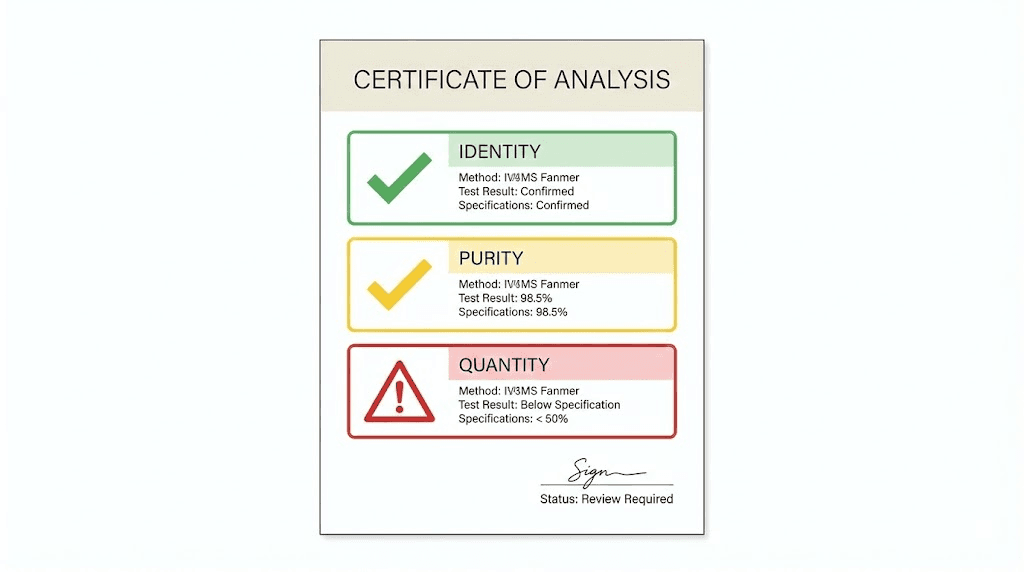
Peptide High Quality: Significance Of Third-party Recognition Without independent confirmation, you're trusting marketing claims over scientific proof. And in the peptide world, that assumption can bring about squandered money, fell short research study, and possibly significant safety and security issues. You've bought peptides from what looked like a respectable supplier. The item got here with a certificate of analysis showing 99% purity. In instance I do not see you, good mid-day, great night, and excellent evening. Might your tests remain precise, your peptides stay pure, and your research remain validated. Given the popularity of substances gone over in resources like the semaglutide versus tirzepatide contrast, confirmation guarantees study with the intended compound. Collective watchfulness improves quality requirements throughout the marketplace by rewarding quality suppliers and exposing problematic ones. Conventional testing normally takes 5-7 organization days from sample receipt. Before devoting considerable cash to huge quantity acquisitions, examining a sample gives guarantee that the bulk order will certainly satisfy assumptions. A strong test report can support pureness, identity, and set traceability. It does not turn a study compound right into a clinical product, and it does not change experimental recognition in the scientist's own system. The peptide example is dissolved in a suitable solvent and packed right into an autosampler. The injector introduces a specific quantity of sample right into the mobile-phase stream.
Greetings Researchers,
The peptide market operates largely without regulatory oversight. Unlike pharmaceutical medications that undertake rigorous screening before getting to customers, research study peptides exist in a grey location where quality depends entirely on vendor honesty. Researchers typically review purity alongside identity verification, testing approaches, and overall documentation. You can assess analytical paperwork for BPC-157, TB-500, Semaglutide, CJC-1295 with DAC, and all other compounds in our study peptide brochure before placing an order. For exploratory testing assays where harsh activity information suffices, 95% pureness might be acceptable. For measurable receptor binding researches, IC50 decisions, or any study where dose-response precision matters, ≥ 98% purity is strongly liked. The 5% pollutant load in a 95% pure preparation is not insignificant in organic assay systems conscious nanomolar concentrations.Store Coa-verified Research Study Peptides
Is 95% pureness helpful for peptides?
Peptides with an 85% purity level or greater are generally utilized in enzyme assays or organic activity research studies. Peptides with purity more than 95% are exceptional for measurable evaluation.
- For numerous purchasers, logical documentation is an essential component of vendor option.Underdosed compounds create suboptimal results that lead scientists to abandon effective methods too soon.For a 10-residue peptide with 99.5% coupling effectiveness, you would certainly expect concerning 95% of the final product to be the unabridged series before purification.The purity portion comes from contrasting the location of the major peak to the overall location of all spotted peaks.Oxidized variants might act as partial agonists or antagonists.These counterions aren't "pollutants" in the HPLC feeling-- they don't appear as separate optimals-- however they do add to the total mass of the powder.